

Hidden costs of living near a high-traffic road
🛣️ Roadside environments are among the most polluted zones in the landscape, where airborne particulate matter (PM) and the elements it contains settle on plants, forming a physico-chemical stress layer for herbivorous organisms. Although some insects — especially species considered plant pests — are sometimes observed in high numbers in such locations, this can lead to the mistaken belief that pollution does not significantly affect them.
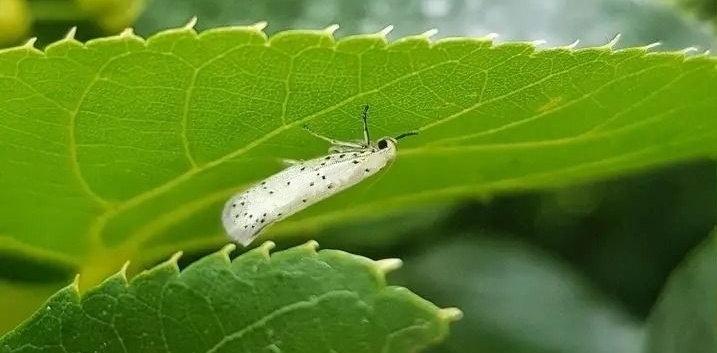
🦋 In a recent article published in Scientific Reports, Dr Hanna Moniuszko, Dr hab. Robert Popek (SGGW Professor), Dr hab. Arkadiusz Przybysz (SGGW Professor) and Dr hab. Adrian Łukowski (UPP Professor) examined how the orchard ermine moth (Yponomeuta padella), a species whose caterpillars feed gregariously on the leaves of trees and shrubs often growing along roads, responds to road dust.
🐛 Larvae were reared on leaves of hawthorn and cherry plum collected from three zones forming a pollution gradient: sites distant from the road (control), the sidewalk, and the immediate roadside verge. Caterpillars that could choose their food clearly avoided the most polluted leaves, regardless of the host plant species. Individuals that had no choice and fed on PM-covered leaves developed more slowly, pupated less frequently, and reached lower body mass compared with individuals fed leaves from the sidewalk and control sites.
🌿 Importantly, although the two host plant species differed in leaf hardness and surface characteristics, the level of pollution proved to be the factor with the strongest effect on insect development. The results show that even if some species can persist along roads, they pay hidden costs in the form of poorer condition. Road-derived pollution may therefore act as an ecological “filter,” gradually shaping insect communities and contributing to the degradation of roadside ecosystems.
Moniuszko, H., Popek, R., Przybysz, A. Łukowski, A. 2026. Responses of tree defoliators to traffic-derived particulate matter and trace elements along a roadside pollution gradient. Scientific Reports [in press] https://doi.org/10.1038/s41598-026-41296-7