

The Christmas tree under the microscope, or a Christmas Eve story about the air in your home
🎀When Christmas trees appear in homes and the scent of pine needles mixes with the aroma of gingerbread, an article has been published that encourages us to look at Christmas trees from a completely different perspective—through the prism of air quality.
🎄Christmas trees are an integral part of Christmas tradition. Fans of natural Christmas trees can choose from many species, available both in cut and potted form. However, we rarely think about what they bring to our homes, apart from the smell of the forest.
✨Meanwhile, conifers are plants that are extremely effective at accumulating dust suspended on the surface of their needles. It was this fact that prompted the staff of the Centre for Climate Research SGGW (Dr. Hanna Moniuszko, Dr. Arkadiusz Przybysz, Prof. SGGW, and Dr. Robert Popek, Prof. SGGW) and their graduate students to investigate whether the method of Christmas tree production—cut or potted—affects the amount of dust brought into homes and the trees’ ability to subsequently capture pollutants indoors.
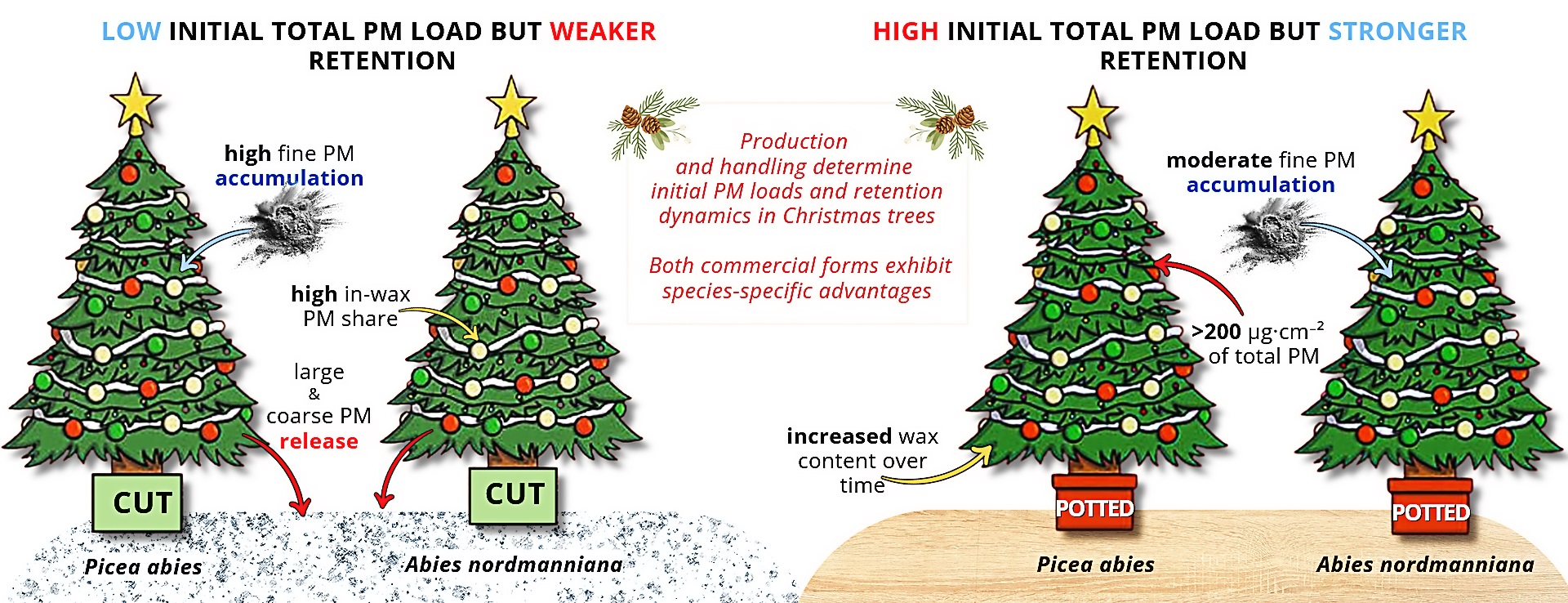
🌲The study covered the two most popular species: Norway spruce (Picea abies) and Nordmann fir (Abies nordmanniana) — in both commercial forms. The results were clear: the differences between cut and potted Christmas trees are significant.
📊Cut trees, regardless of species, bring significantly less dust into the interior than potted trees. This is mainly due to the way they are transported and stored, which promotes the mechanical removal of particles even before purchase. However, as physiologically inactive plants, over time they begin to release mainly larger and medium-sized dust particles, becoming an additional source of pollution.
📊Potted Christmas trees behave differently. Although they initially bring more dust into homes, they retain it much better on the surface of their needles. Their physiological activity promotes more stable particle retention over time.
📊However, it is worth noting that in the case of the smallest dust fraction—the most harmful to health—there is no universal rule. Effective accumulation of this fraction has been observed in both potted spruce and cut fir trees.
🔔Choosing a Christmas tree for your home is therefore a compromise between aesthetics, an eco-friendly approach, and whether you treat the Christmas tree as a decoration or also as a temporary air filter.