

What happens when another species suddenly appears in an area occupied by a single species that specializes in a particular food source?
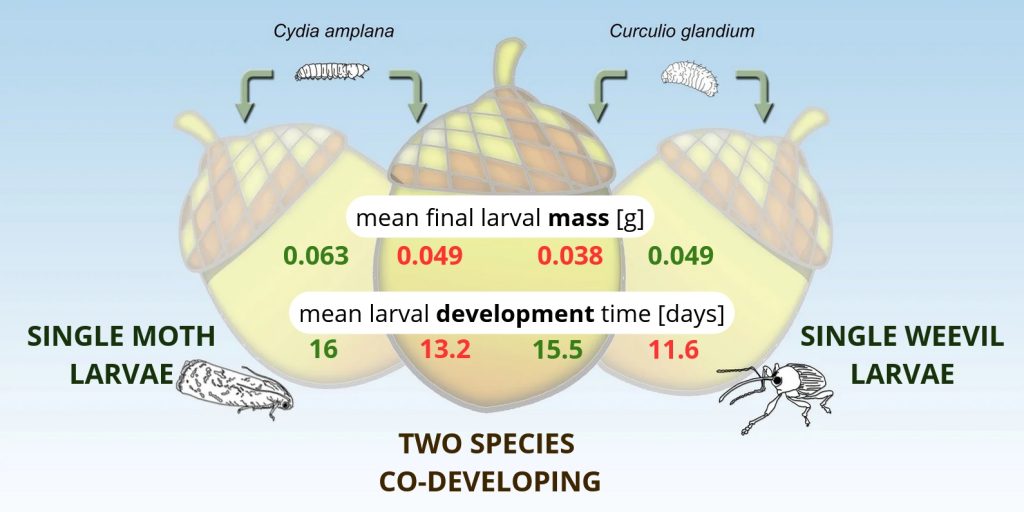
🌳 In 2022, the SGGW campus, which has been inhabited for years by the acorn weevil (Curculio gladium), saw a large infestation of the oak moth (Cydia amplana).
🐛 The larvae of both species develop inside acorns, which they also feed on. The difference between them is that female weevils bore into acorns and lay their eggs inside, while female moths lay their eggs on the surface of acorns and only then do the larvae bite their way inside.
❓ However, in 2022, “strange” acorns appeared—they had traces of weevil drilling, but contained unusual eggs. After incubation in the laboratory, caterpillars of the oak processionary moth emerged from the acorns, which was confirmed by genetic testing (COI).
🦋 This is the first observation of such behavior in the oak moth. Therefore, Dr. Michał Reut (Department of Plant Protection, Faculty of Horticulture) and Dr. Hanna Moniuszko (Climate Research Center, Warsaw University of Life Sciences) together with their colleagues (Dr. Mariusz Chrabąszcz, Dr. Tobiasz Druciak) examined the results of direct competition between weevil and moth larvae in a single acorn.
💀It turns out that in a shared acorn, where competition was very intense compared to the control group with larvae kept individually, the mortality rate of both species was around 50%. In addition, due to the limited amount of food, both species achieved lower body weight. However, their development was prolonged in the case of the weevil and shortened in the case of the moth, which was probably due to an attempt to limit the time of direct competition with the weevil.
☀️The phenomenon described is most likely related to the expansion of the range of the oak leaf roller. This, in turn, is a result of the warming climate, which favors the migration of insects to areas that were previously too cold for them.
The study was published in the prestigious journal Ecological Entomology, edited by the Royal Entomological Society in the United Kingdom.
https://resjournals.onlinelibrary.wiley.com/doi/10.1111/een.70052